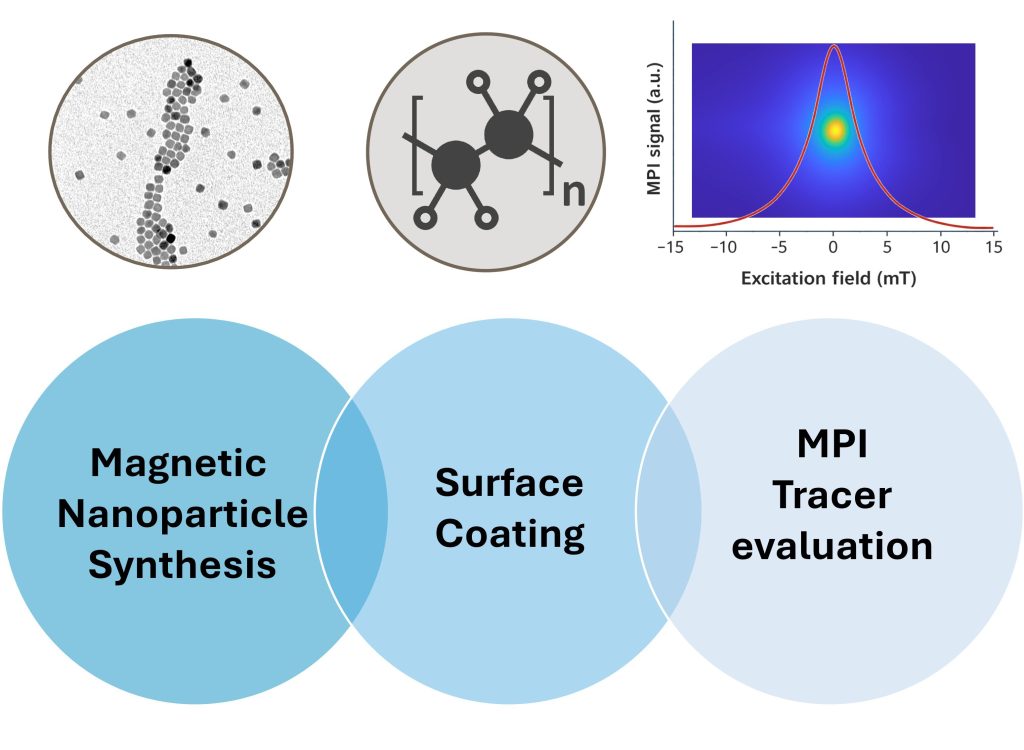
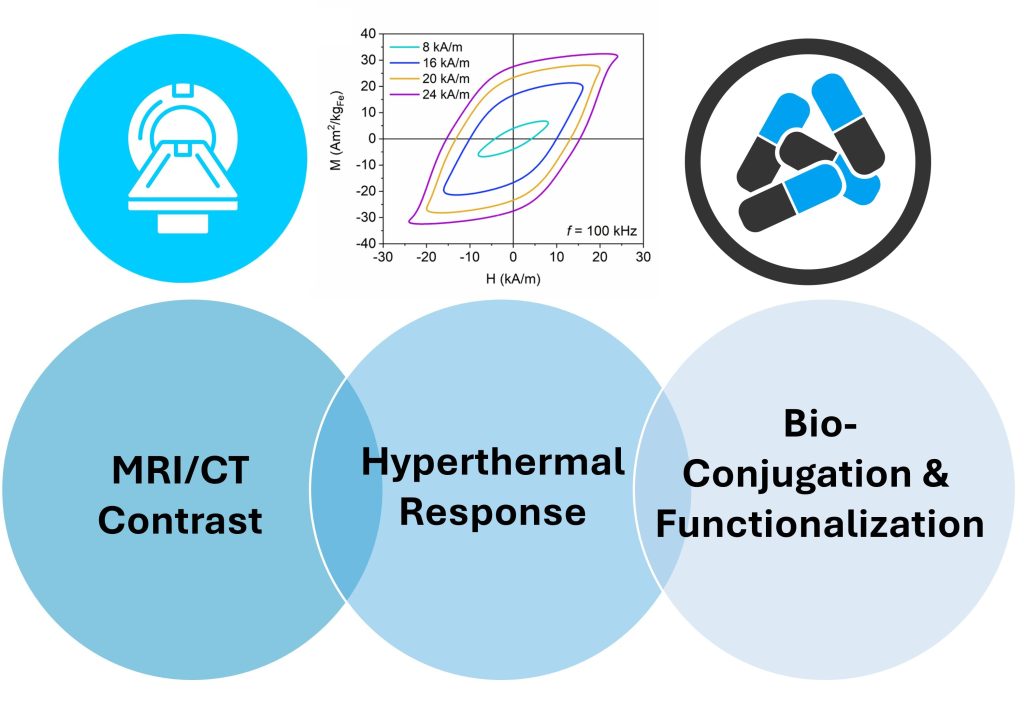
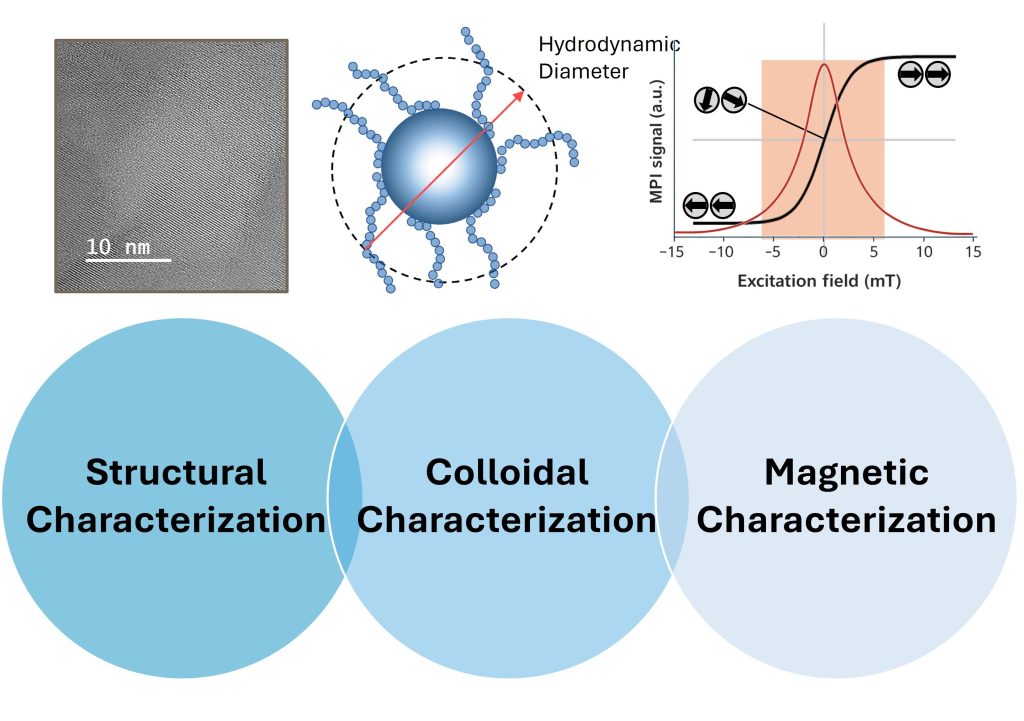
This WG focuses on the optimization of magnetic nanoparticles (MNPs) as tracer materials in MPI, with particular emphasis on their magnetic properties to achieve a strong imaging signal while ensuring clinical feasibility. For advanced MPI applications, additional characteristics and functionalities may be required, such as efficient heat transfer for hyperthermia (see Goals of WG3 in the Table below). WG 3 addresses the following tasks: reviewing the literature; mapping current technological advances in MNP synthesis relevant to MPI applications; developing and optimizing MNP synthesis strategies; and performing comprehensive characterisation and evaluation of MNPs, all in close cooperation with WG1, WG2, and WG4.
Goal 1: Optimize NPs design to ensure strong imaging signals.
Goal 2: Extending NPs functionalities for advanced MPI applications.
Goal 3: Study structure, stability and magnetism of MPI tracers.
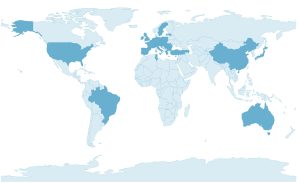
Geographical distribution of WG3 participants in the NexMPI COST Action.
WG3 leader
Dr. Helena Gavilán is a Ramón y Cajal Research Fellow at the Universidad Complutense de Madrid, where she leads the NanoColloids & Magnetism Lab in the Department of Physical Chemistry. Her research focuses on the design, scalable synthesis, and magnetic characterization of magnetic nanoparticles for biomedical applications. She earned her PhD from the Institute of Materials Science of Madrid (ICMM-CSIC) and completed postdoctoral research at leading international institutions, including the Italian Institute of Technology. She currently coordinates national and international projects on responsive nanomaterials and represents UCM on the Una Europa Alliance Self-Steering Committee for Future Materials and Technologies.
WG3 co-leader
Dr. Marco Giardiello is a Senior Lecturer in Chemistry and UKRI Future Leaders Fellow specialising in nanomedicine and medical imaging. He obtained his PhD from the University of Leicester in biological inorganic chemistry (2007), developing responsive MRI contrast agents and lanthanide probes. Following postdoctoral research in Liège and at CEA Grenoble, he joined the University of Liverpool developing HIV nano-therapies, which led to cGMP manufacture for first-in-human trials and co-founding of the spin-out Tandem Nano Ltd. In 2022, he secured the UK’s first MPI Scanner (MomentumTM, Magnetic Insight inc.) through an EPSRC equipment award, thus much of his current research is centred around particle development as MPI tracers and hyperthermia therapy.
Publications
Representative selection
C. Pinto, G., Costa, J. M., P. Fernandes, S., Resende, G. F., TC Coimbra, E., Vogel, P., … & O. Silva, N. J. (2025). Enabling Real‐Time, Non‐Ionizing 3D Imaging of Implantable Magnetic Cements Using Magnetic Particle Imaging. Advanced Materials Interfaces, e00757. https://doi.org/10.1002/admi.202500757
2. Gavilán, H., Gallo-Cordova, A., Chediak, M. L. R., Rodíguez, A. P., del Puerto Morales, M., & Gutierrez, L. (2025). Magnetic hyperthermia in focus: emerging non-cancer applications of magnetic nanoparticles. Nanoscale, 2025,17, 27734–27761. https://doi.org/10.1039/D5NR03329B